Build faster, connect more, and bring AI into real business workflows.
Celigo’s May release is designed to help teams move faster across automation, AI, connectivity, EDI, and marketplace discovery. From agentic automation enhancements to new integration templates and B2B improvements, this release brings more flexibility, visibility, and intelligence into the Celigo platform.
Agentic Automation
MCP prompts for AI agents
Celigo AI agents will be able to discover and use prompt templates through a unified interface via connected MCP servers.
With this enhancement, users can map required inputs directly in the UI and apply explicit allowlists to control which capabilities an AI agent can access. This gives teams more structure, control, and governance when building agent-powered automations.
Google Gemini for AI agents
Celigo is expanding model choice in Agent Builder with support for Google Gemini models alongside existing OpenAI options.
Users will be able to select Gemini models from the Agent Builder model picker and configure them using bring-your-own-key setups. Gemini support is also being added to model comparisons, making it easier to evaluate model performance for different business workflows.
Platform
Tools in flows
Tool-based business logic can now be reused directly within flows as an import step.
This allows teams to standardize logic across the Celigo platform and reduce maintenance by eliminating duplicate configurations that were previously limited to Agents. With tools in flows, reusable business logic becomes easier to manage, scale, and govern.
Resolve errors faster with Celigo Ora
Celigo Ora is bringing AI-powered error analysis directly to the errors page.
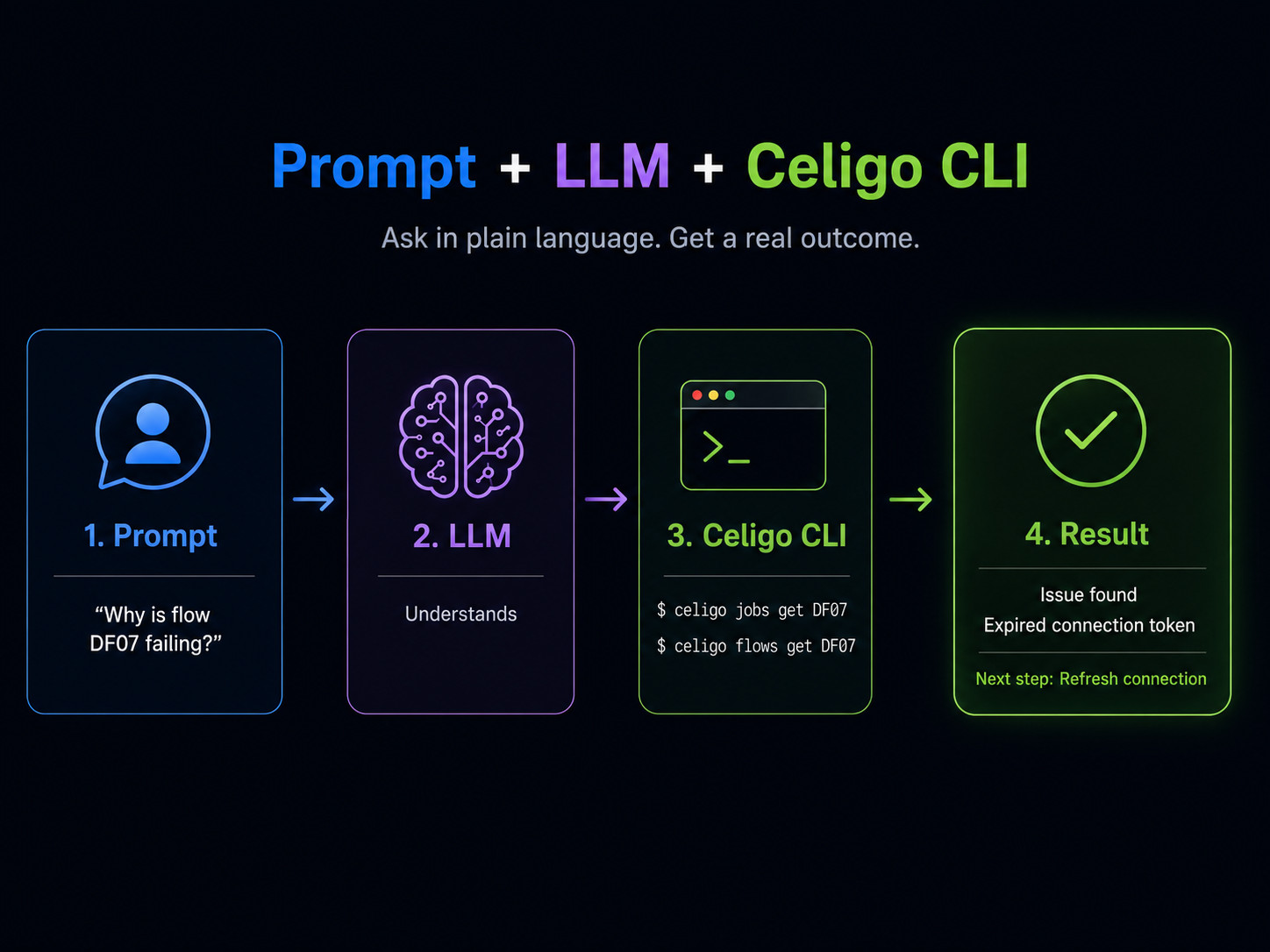
Ora analyzes the specific context of an integration error and provides plain-language explanations with recommended next steps. This helps users understand issues faster, reduce troubleshooting time, and move from error detection to resolution more efficiently.
Connectivity
New Shopify–NetSuite GraphQL integration template
The new Shopify–NetSuite GraphQL integration template provides a prebuilt foundation for automating core ecommerce processes between Shopify and NetSuite.
Instead of starting from scratch, teams can begin with ready-made flows that support the operational side of the customer experience, including:
- Orders
- Fulfillment
- Inventory
- Payouts
- Returns
This template helps ecommerce and operations teams accelerate implementation while reducing manual setup effort.
B2B Manager
NetSuite cartonization and shipping labels
Celigo is adding native support for generating shipping labels and managing cartonization within NetSuite integrations.
This enhancement helps streamline fulfillment workflows by supporting more of the shipping and packaging process directly within connected NetSuite operations.
EDI acknowledgement file visibility
Users will be able to view and download Functional Acknowledgment files directly from the EDI dashboard.
This gives teams clearer visibility into whether trading partners have accepted outbound transactions, helping improve transparency and reduce follow-up effort across EDI operations.
Integration Marketplace
Find AI-powered solutions faster
AI-powered solutions are becoming easier to identify in the Celigo Marketplace through new AI badges and a dedicated AI-focused section.
This helps users quickly discover AI-powered Integration Apps, templates, agents, and guardrails without having to manually search through every Marketplace result.
New TP and HTTP connectors
The May release also includes new TP and HTTP connectors, expanded endpoint coverage, and enhancements across several existing integrations.
These updates continue to broaden Celigo’s connectivity ecosystem and make it easier for teams to automate across more systems and workflows.